
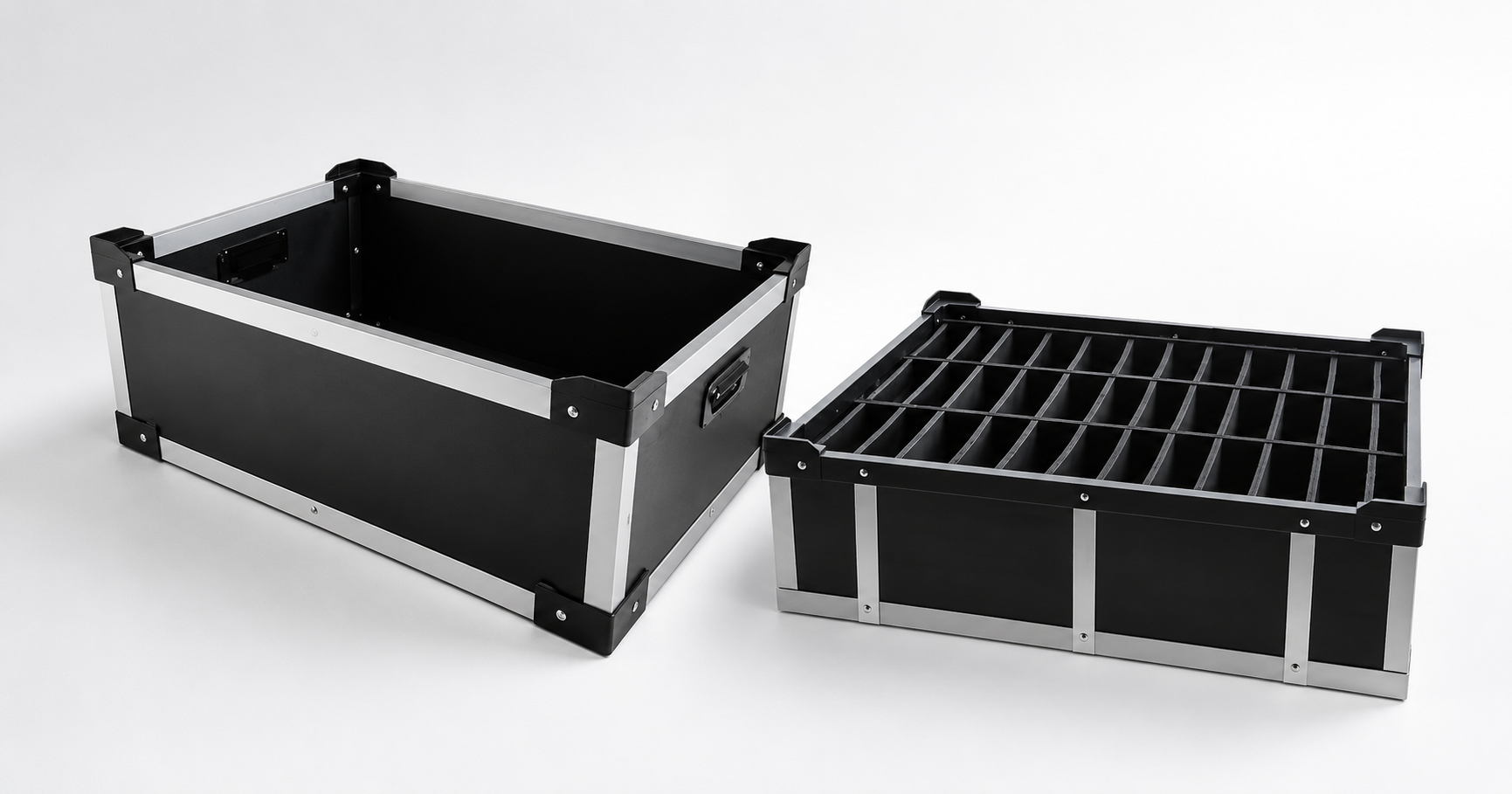
Most purchase managers only start asking this question after something goes wrong a batch of PCBs fails quality inspection, a set of MOSFET modules shows erratic behaviour, or a customer complaint traces back to handling damage that left no visible mark. Electrostatic discharge is invisible, cumulative, and expensive to diagnose after the fact. If your factory handles electronic components, sensors, or circuit assemblies at any stage, understanding antistatic bins is worth thirty minutes of your time before it costs you a rejected shipment. As an antistatic bin manufacturer in Ahmedabad, Shanti Polymers works with electronics and automotive electronics suppliers who navigate this decision regularly.
Here is what you actually need to know.
What Electrostatic Discharge Does to Electronic Components
Static electricity builds up through ordinary activity a person walking across a floor, a component sliding against a plastic surface, or a bin being dragged across a workbench. The human body can carry a charge of 1,000 to 35,000 volts depending on footwear, flooring, and humidity. Most sensitive electronic components begin sustaining damage at charges as low as 100 volts. Many fail at 10 to 20 volts levels you cannot feel, see, or detect without measurement equipment.
The damage from ESD falls into two categories. Hard failures are immediately visible the component stops working and gets caught at testing. Latent failures are more dangerous. The component passes initial QC but carries micro-damage that causes it to fail in the field, sometimes months after installation. Field failures are significantly more expensive to resolve than line rejections.
This is why packaging and storage containers not just operator grounding are part of a complete ESD control programme.
What an Antistatic Bin Actually Is
An antistatic bin is a storage or transit container manufactured from PP (polypropylene) material that has been compounded with conductive or dissipative additives. These additives modify the surface resistance of the material, allowing any static charge that builds up on the container to dissipate safely rather than discharge suddenly onto a component placed inside.
There are three distinct types, and the terminology is frequently confused:
- Antistatic: Resists the generation of static charge on the surface. Surface resistance typically above 10¹² ohms. Suitable for outer packaging where the component is already protected by an inner ESD bag.
- Static Dissipative: Allows charge to flow slowly enough to reduce the chance of a sudden discharge. Surface resistance in the range of 10⁶ to 10¹¹ ohms. The most common choice for bin and tray applications in electronics manufacturing.
- Conductive: Allows charge to flow freely and rapidly to ground. Surface resistance below 10⁶ ohms. Used in specific applications where rapid grounding is required, usually with grounding straps.
For most production line and storage applications, static dissipative bins are the correct specification.
Where Antistatic Bins Are Needed and Where They Are Not
Not every part of your factory requires ESD-rated containers. Knowing where the boundary sits saves unnecessary cost without compromising protection.
You need antistatic bins when:
- Bare electronic components PCBs, ICs, transistors, sensors are handled or stored without an inner protective bag
- Components move through a defined EPA (Electrostatic Protected Area) where ESD control is part of your process documentation
- You supply to OEMs or Tier-1 customers whose quality audits include ESD compliance checks
- Your product is assembled into automotive ECUs, industrial controllers, medical devices, or telecom equipment
Standard PP bins are adequate when:
- Components are fully enclosed in antistatic bags throughout handling and storage
- You are handling non-sensitive components mechanical parts, rubber gaskets, fasteners, castings
- The bin is used outside the EPA for general material movement
Practical tip: Check your customer’s quality agreement before specifying containers. Many OEMs in Gujarat’s automotive electronics supply chain now mandate ESD-compliant packaging as a contractual requirement not just a recommendation. Getting this wrong can trigger a supplier audit.
How Antistatic Bins Fit Into a Broader ESD Control Programme
A bin alone does not make a process ESD-safe. It is one layer in a system that typically includes:
- Flooring: ESD-dissipative floor tiles or mats connected to ground
- Operator grounding: Wrist straps or heel grounders worn by anyone handling sensitive components
- Workbench surfaces: Dissipative mats connected to a common ground point
- Storage containers: Antistatic bins, trays, and racks within the EPA
- Signage and zoning: Clearly marked EPA boundaries and visitor protocols
If you invest in ESD bins but your operators are wearing standard rubber-soled shoes on vinyl flooring with no grounding, the bins are doing partial work at best. ESD control is a system problem, not a packaging problem alone.
That said, the bin is often the easiest and most cost-effective layer to implement first, particularly for operations building towards full IEC 61340-5-1 compliance.
Choosing the Right Antistatic Bin Manufacturer in Ahmedabad
The quality gap between ESD bins from different suppliers is significant and not visible to the naked eye. The additive loading, sheet consistency, and post-moulding quality checks all affect whether the bin actually performs within the dissipative range after six months of use or drifts outside it.
Questions worth asking any supplier before placing an order:
- What is the surface resistance range of your standard dissipative bin, and how is it tested?
- Can you provide a batch-level test certificate?
- Does the ESD performance degrade with cleaning agents, and if so, what cleaning is compatible?
- What wall thickness and cavity configuration do you recommend for our specific component weight and handling cycle?
Why Choose Shanti Polymers?
Shanti Polymers manufactures antistatic bins and ESD packaging in Ahmedabad solutions in-house at their facility, with material compliance documentation available on request. Their team works directly with purchase and quality managers to match bin specification material grade, surface resistance, size, and foam fitment if required to the actual handling conditions in your plant.
ESD damage is a silent cost that most factories underestimate until a field failure or a failed OEM audit forces the conversation. The right antistatic bin, correctly specified and used as part of a broader ESD programme, is one of the more straightforward investments in component quality you can make.
Contact Shanti Polymers for a free quote and material compliance information.