
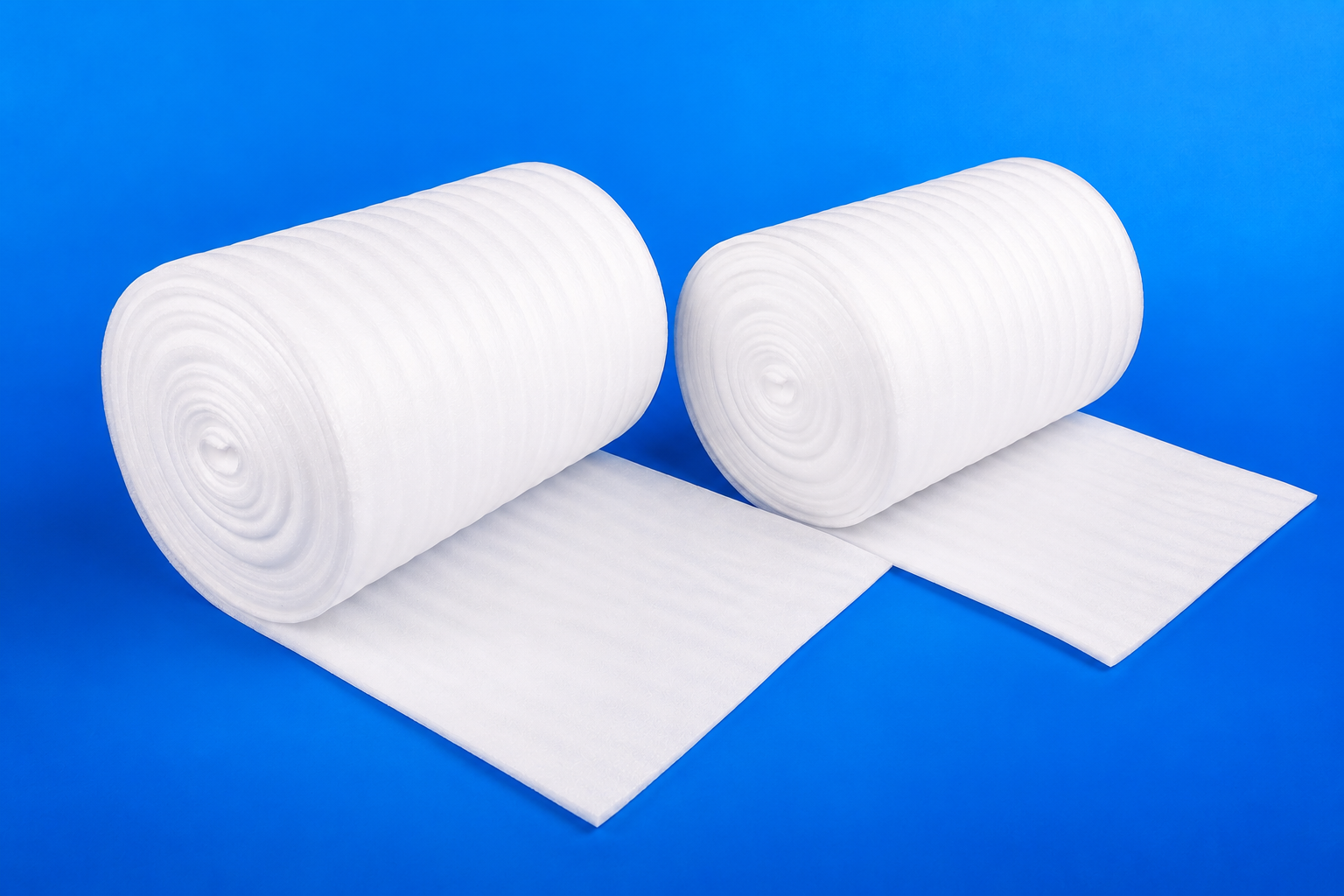
Most packaging decisions get made under time pressure a new product, a delivery deadline, a purchase order that needs to go out. EPE foam rolls end up on the spec sheet because someone used them before, or because they were available quickly, or because the price was right that week.
The operations heads we work with at Shanti Polymers across automotive, electronics, and pharma packaging in Gujarat eventually get to the same place: they want to know they’re using the right foam for the right reason, not just the foam that was easiest to order. As an EPE foam fitment manufacturer in Ahmedabad, that’s the conversation we have most often, and this guide covers the answers.
What Makes EPE Foam Different From Other Foam Materials
EPE stands for Expanded Polyethylene. The manufacturing process expands low-density polyethylene resin with a foaming agent, creating millions of closed air cells within the foam structure. Those cells are what give EPE its characteristic soft-but-firm feel and its ability to absorb impact without collapsing permanently.
Compare this to PU foam, which is a thermoset material it compresses under load and doesn’t fully recover. Or EPS (thermocol), which is rigid, brittle, and sheds particles during handling. EPE recovers its shape after compression, doesn’t shed debris, and resists both moisture and most industrial chemicals.
For a purchase manager evaluating materials for a new packaging line, that recovery property matters practically. A foam that doesn’t bounce back after the first transit cycle is a foam you replace every trip. EPE typically holds its cushioning properties across multiple handling cycles, which directly reduces your per-unit packaging cost over time.
Why Rolls Not Sheets or Bags Have Become the Default Format
EPE is available in rolls, sheets, bags, and custom fitments. Rolls have become the preferred stocking format on most production lines for one practical reason: a single roll SKU serves every product size on the line.
The roll format advantage:
- One roll width covers multiple product dimensions: the operator cuts what they need at the workstation
- No SKU proliferation: you don’t need a separate bag size for each product variant
- Faster packing cycle: cutting from a roll is quicker than opening and inserting a pre-formed bag for operators running high-volume lines
- Easier inventory management: one material, one reorder point, one supplier conversation
Where rolls are not the right choice:
- High-speed automated packing lines where pre-formed bags reduce operator handling time
- Components with complex geometries that need a shaped fitment to hold them fixed during transit
- Electronics with ESD sensitivity standard EPE rolls are not antistatic; ESD-grade EPE should be specified separately
The Density Question What Most Buyers Get Wrong
Thickness is what most buyers look at first. Density is what actually determines whether the foam does its job.
EPE foam density reference guide:
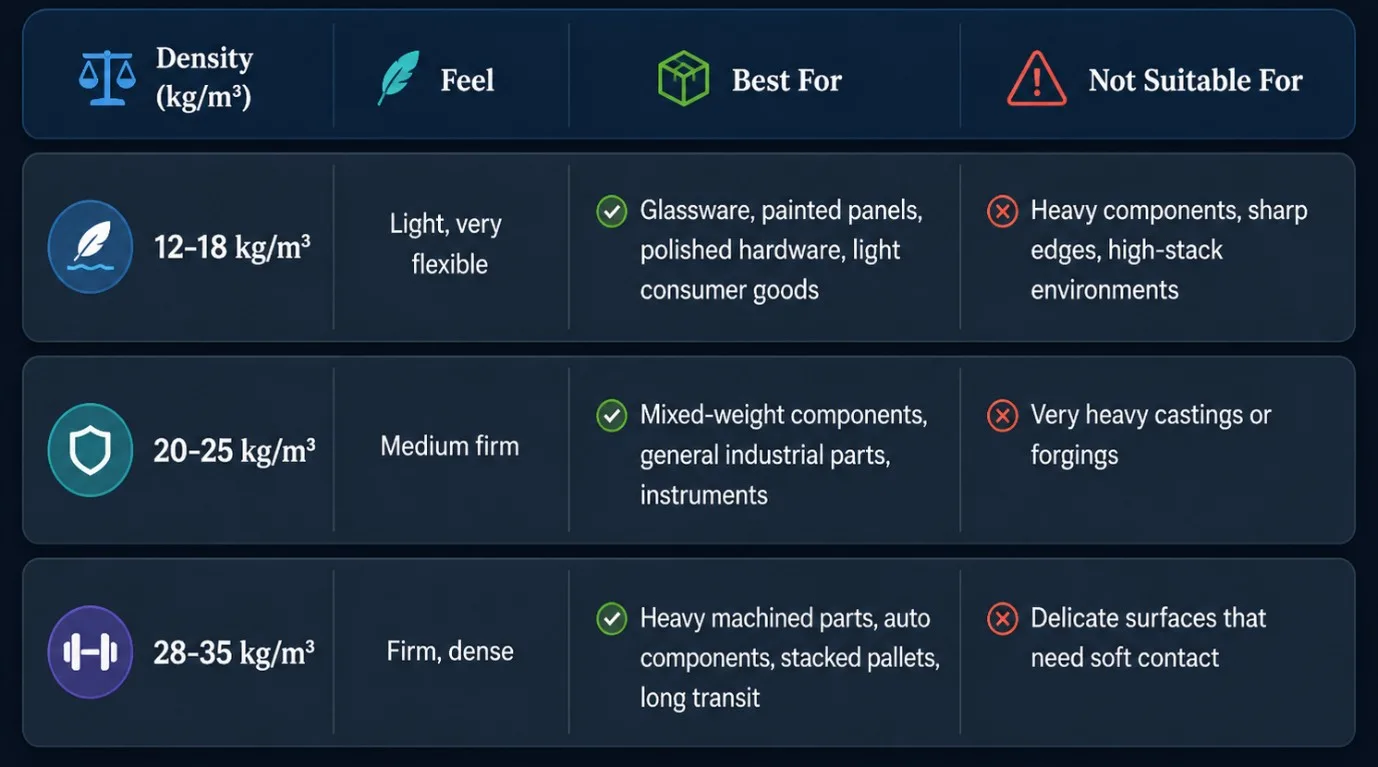
The mistake that costs factories the most:
Using low-density foam (12–18 kg/m³) on components weighing 3 kg or more. The foam bottoms out under load especially when boxes are stacked 4–5 high on a delivery vehicle and provides no meaningful cushioning by the time the product arrives. This is the exact scenario that leads to damage claims that get blamed on the carrier, when the root cause is the foam specification.
How EPE Foam Rolls Work Alongside Custom Fitments
Rolls and fitments serve different functions within the same packaging system and using both together gives you the most complete protection.
The two-layer approach most Gujarat factories now use:
Layer 1 Custom EPE fitment (inner)
- Die-cut or CNC-routed insert shaped to the component’s geometry
- Holds the component in a fixed position prevents shifting during transit
- Handles precision positioning for sensitive or fragile components
Layer 2 EPE foam roll wrap (outer)
- Cut from a roll and wrapped around the fitment assembly
- Provides surface cushioning between the fitment and the box wall
- Fills any remaining void space without requiring additional packaging material
Why this works better than either layer alone:
- Roll only → component can shift inside the box if wrapping is inconsistent between operators
- Fitment only → surface areas remain exposed to contact with the box wall on impact
- Both together → fixed positioning + complete surface protection without over-engineering
This two-layer approach is standard in electronics packaging across Ahmedabad’s Changodar and Odhav GIDC clusters, where mixed-component boxes need both component isolation and impact absorption in the same transit cycle.
Why Choose Shanti Polymers?
Shanti Polymers manufactures EPE foam rolls, sheets, and custom fitments in-house at their Sanand GIDC facility in Ahmedabad, with density options, core sizes, and roll widths matched to your actual production line requirements. As a direct EPE foam fitment manufacturer in Ahmedabad, their team works with your purchase and engineering teams from specification through to bulk production with samples produced before any volume commitment is required.
Getting the EPE foam specification right at the start of a new line or product changeover prevents the transit damage cycle that costs factories far more than the foam itself. The density, the format, the grade, and the integration with your existing box system each one matters, and each one is worth spending time on before the first bulk order goes out.