
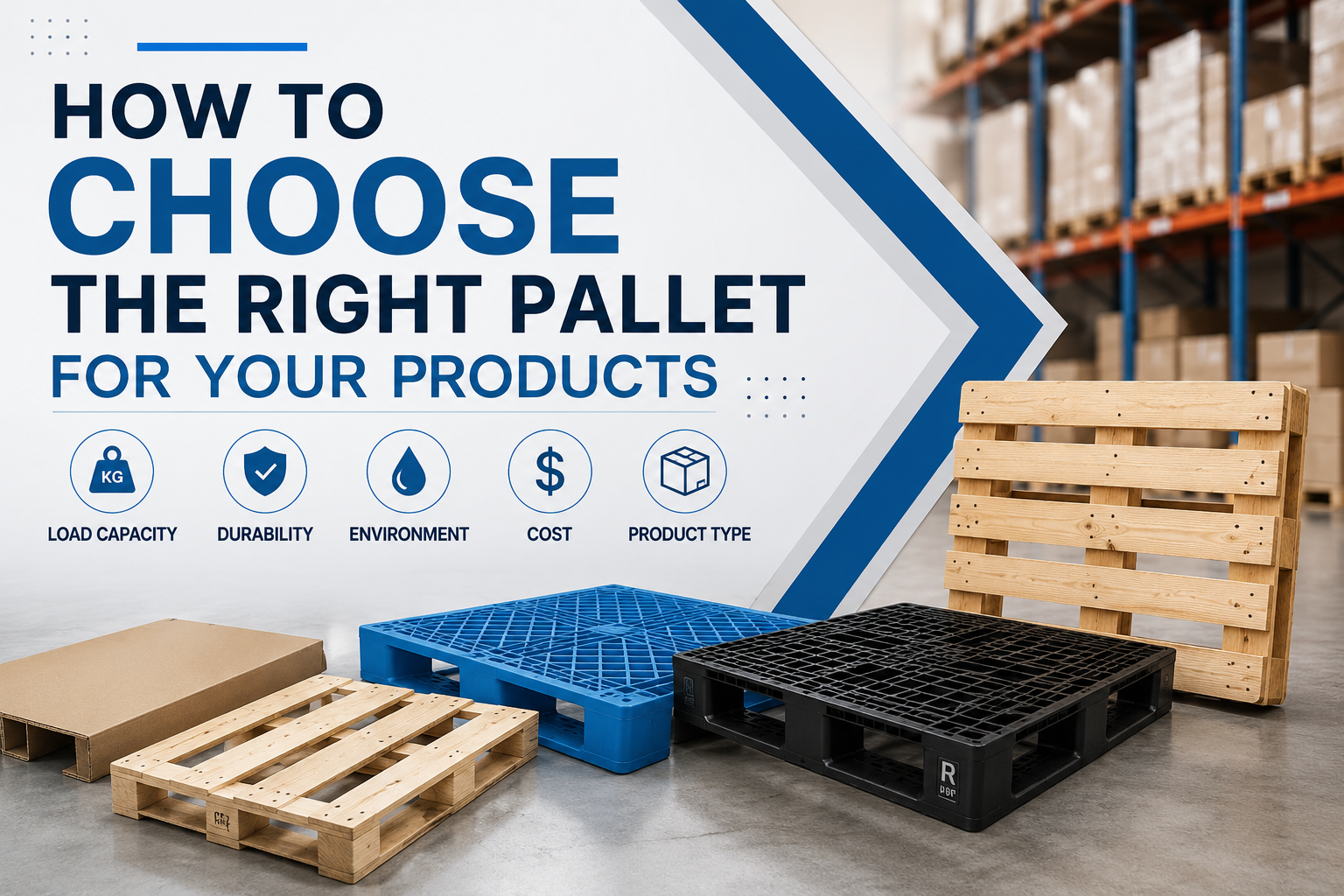
Most warehouse managers choose pallets the same way they chose them five years ago because that’s what was already here when they arrived. It’s one of those decisions that never gets revisited until something goes wrong. A pallet collapses under load. A fumigation rejection delays an export shipment. A wooden pallet splinters and contaminates a pharma batch. Suddenly the question that nobody asked for years becomes urgent.
The right pallet for your operation depends on four things: what you’re moving, how heavy it is, where it’s going, and how many times it needs to make that journey. Get those four answers right and the pallet decision practically makes itself.
Here’s how to work through it.
Why Pallet Choice Affects More Than Just Storage
A pallet is not passive infrastructure. It affects your freight cost, your damage rate, your fumigation compliance, your warehouse floor load calculations, and how efficiently your forklifts and racking systems operate.
Wooden pallets are still the default across much of India’s logistics network. They’re cheap per unit, widely available, and most carriers know how to handle them. But they also splinter, absorb moisture, harbour insects, fail randomly under load, and require ISPM 15 fumigation treatment for international shipments. That fumigation step alone adds cost and lead time to every export consignment.
Plastic pallets address most of these problems but they’re not a single product. There are multiple types with meaningfully different load ratings, entry configurations, and temperature tolerances. Choosing the wrong plastic pallet is a different kind of mistake from choosing wood, but it’s still a mistake.
The Main Pallet Types and What Each One Actually Does
Wooden Pallets:
Standard wooden pallets (typically 1200mm x 1000mm in India) are the right choice when:
- You’re shipping domestically through shared transport with no temperature or contamination requirements
- The pallet is a one-way trip you have no return loop and no intention of collecting it
- Your product is heavy, non-food, non-pharma, and tolerant of slight moisture exposure
- Cost per unit is the primary constraint and cycle life is not a factor
Where they fail: any environment requiring hygiene compliance, international export without fumigation, cold chain logistics, or repeated use across 20 or more cycles.
HDPE Plastic Pallets:
High-density polyethylene pallets are the most widely used plastic pallet format in Indian manufacturing. HDPE is injection-moulded, which means consistent dimensions, predictable load ratings, and no splinting, warping, or moisture absorption.
The practical benefits over wood:
- Static load capacity: typically 5,000 to 8,000 kg depending on specification suitable for dense industrial products
- Dynamic load capacity: 1,000 to 2,000 kg under forklift movement matches most warehouse and logistics requirements
- Cycle life: 50 to 100 trips in normal handling conditions vs 8 to 15 for a standard wooden pallet
- Hygiene: Non-porous surface, no food for insects, easy to wash meets pharmaceutical and food-grade requirements without treatment
- Export compliance: No fumigation required. ISPM 15 applies only to wood packaging materials.
Shanti Polymers supplies HDPE plastic crates and pallets to automotive, pharmaceutical, agricultural, and FMCG manufacturers across Gujarat and India. Their range includes both standard footprint options and custom specifications for specific racking or vehicle configurations.
FLC Foldable Plastic Pallets and Boxes:
Foldable plastic pallet boxes in Ahmedabad serve a different purpose from flat pallets. They combine the pallet base with collapsible sidewalls giving you a stackable, containerised solution that folds flat when empty.
This format is particularly useful for:
- Return logistics where empty containers need to travel back from customer to supplier
- Agricultural produce where you need both containment and stacking in one unit
- Automotive supply chains with fixed routes between Tier-1 supplier and OEM assembly plant
- Any operation where pallet return cost currently eats into margins
A full truck of assembled foldable boxes might require three trucks when collapsed the return freight cost difference is significant at volume.
How to Match Your Pallet to Your Product
Step 1 Calculate Your Load Weight Correctly
This is where most buyers make the first mistake. They specify a pallet based on the heaviest single product they move, but they don’t account for stacking. If you stack three layers of cartons on one pallet and each layer weighs 400 kg, your pallet needs to handle 1,200 kg dynamic load during forklift movement, plus the racking static load above it.
Always specify the total stacked weight, not the product weight alone.
Step 2 Confirm Your Footprint and Entry Configuration
Standard Indian pallets are 1200mm x 1000mm. But some facilities run 1200mm x 800mm European footprints, particularly in export-oriented operations. Measure your racking bay width before ordering.
Entry configuration matters for your equipment:
- Two-way entry: forklift can enter from two sides. Standard and cheaper.
- Four-way entry: pallet jack or forklift can enter from any side. Better for tight warehouses where orientation isn’t controlled.
Step 3 Decide on Cycle Life Requirements
This is the economic decision. A wooden pallet at ₹350 used once has a per-trip cost of ₹350. An HDPE plastic pallet at ₹1,800 used 60 times has a per-trip cost of ₹30.
The crossover point where plastic becomes cheaper than wood is usually between cycle 8 and cycle 12. If your pallet makes more trips than that in any kind of return loop or captive supply chain plastic is the lower-cost option over the full asset life.
Step 4 Check Your Environmental Requirements
Three questions to answer:
- Does the pallet contact food, pharmaceutical product, or medical devices at any point? If yes, non-porous HDPE is required.
- Does the pallet go into cold storage below 0°C? Standard HDPE can become brittle at very low temperatures specify cold-chain grade material.
- Does the pallet leave India? If yes, wooden pallets require ISPM 15 fumigation certification. Plastic pallets do not.
Where Plastic Pallets Supplier Networks in India Are Concentrating
The shift from wood to plastic in India’s formal manufacturing sector has accelerated since 2020, driven largely by food safety regulations, pharmaceutical GMP requirements, and increased export documentation scrutiny.
Gujarat leads this transition among Indian states partly because of the concentration of pharmaceutical and chemical manufacturing in Ahmedabad, Vadodara, and Bharuch, where hygiene-grade packaging is not optional. Automotive clusters in Sanand and Ahmedabad have also moved heavily toward plastic pallets and HDPE crates for in-plant material movement, where consistent dimensions matter for racking system compatibility.
The practical implication for buyers: plastic pallets and HDPE crates are no longer a premium niche product in Gujarat. They’re standard specification in most formal manufacturing environments, and the pricing has moved accordingly.
A Note on HDPE Crates vs Pallets They’re Not the Same Thing
This distinction gets blurred in supplier catalogues.
- An HDPE crate has sidewalls and is designed to contain loose or irregularly shaped product agricultural produce, automotive components, bottled goods. It sits on a pallet or is stacked directly on another crate.
- An HDPE pallet is a flat base with no sidewalls, designed to carry stacked cartons, bags, or other packaged goods. It interfaces with forklifts, pallet jacks, and racking systems.
- Many operations need both: crates for the product, pallets for moving stacked crates through the warehouse and onto vehicles. Getting clear on which you need before approaching a supplier saves a round of samples and revised quotes.
Why Shanti Polymers?
Shanti Polymers manufactures HDPE pallets Ahmedabad facility, supplying automotive, pharmaceutical, FMCG, and agricultural clients across Gujarat and India. As a direct manufacturer rather than a distributor, they can advise on load ratings, footprint compatibility, and cold-chain specifications based on your actual handling conditions not a generic catalogue recommendation.
Visit shantipolymers to explore the full HDPE product range or contact the team directly for a specification consultation.