

The cardboard box sitting in your dispatch bay right now has probably already done its last useful trip. You just don’t know it yet.
Cardboard corrugated boxes degrade with every cycle. The first time a cardboard box gets wet, stacked too high, or left in a humid warehouse through Gujarat’s monsoon months, its structural integrity drops significantly. Most operations managers know this instinctively they’ve seen the collapsed stacks, the bent corners, the boxes that arrive at the customer looking like they’ve been through something difficult. What they often haven’t done is calculate what that single-use reality actually costs across a full year of production.
The question of how many times you can reuse a corrugated box has two very different answers depending on which corrugated material you’re talking about. For paper cardboard, the answer is discouraging. For PP corrugated, the answer changes the economics of your packaging operation entirely.
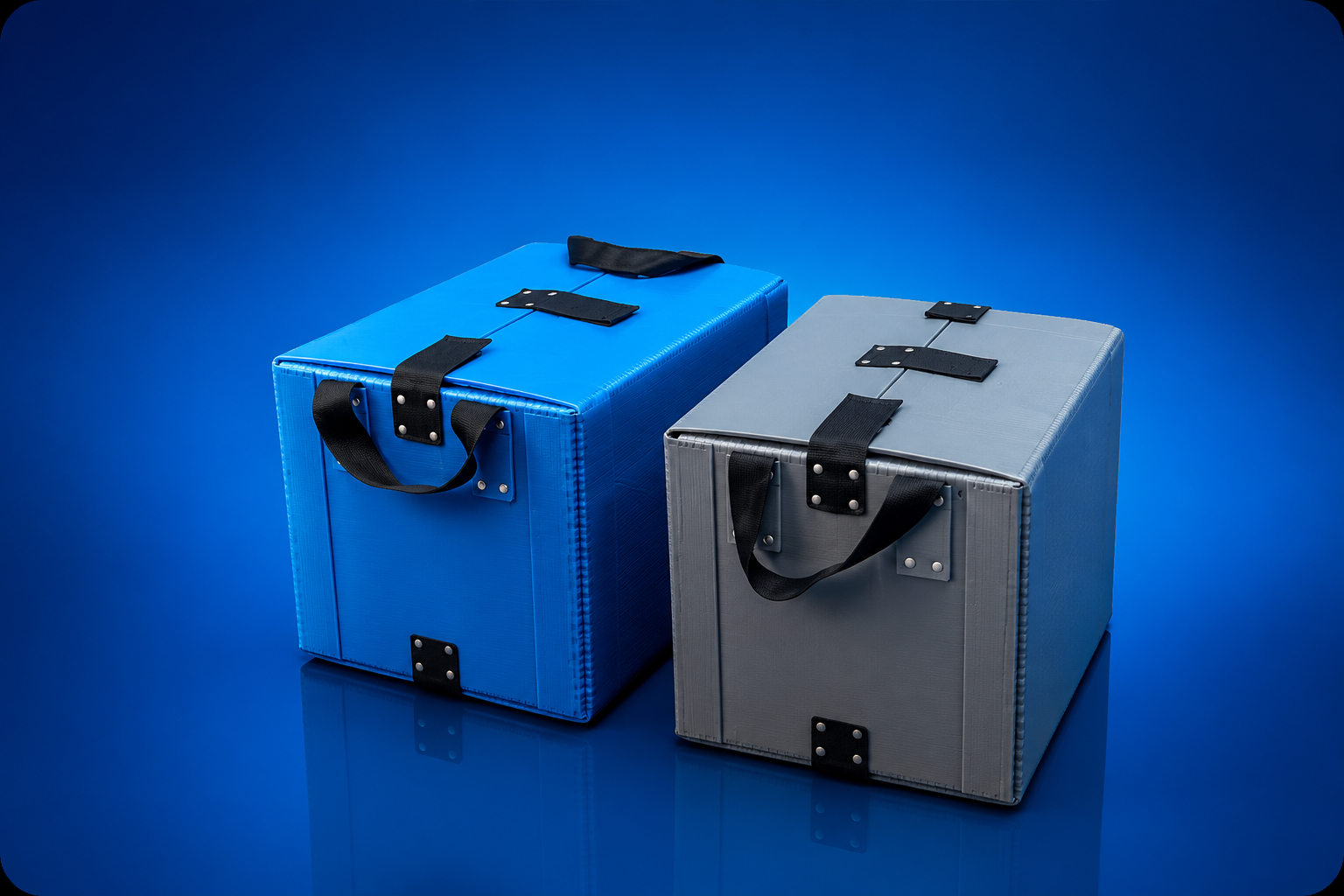
Cardboard Corrugated Boxes The Honest Answer
Standard cardboard corrugated boxes are not designed for reuse. They’re engineered for a single transit cycle and optimised for cost per unit rather than cost per trip.
In practice, most factories reuse them anyway. A box comes in with a component delivery, gets repacked with outgoing goods, and goes back out. This works until it doesn’t until the base fails under load, the top flap won’t close properly, or the edge crush strength has degraded enough that stacking four high becomes a structural risk.
The actual reuse ceiling for cardboard corrugated under normal handling:
- Dry warehouse conditions, light loads: 2 to 3 cycles before visible structural compromise
- Mixed indoor-outdoor handling: 1 to 2 cycles before moisture absorption begins degrading strength
- High-humidity environments (Gujarat monsoon season): 1 cycle reliably, after which moisture uptake accelerates failure dramatically
- Stacked in a delivery vehicle under load: Often fails to meet original spec by the end of a single round trip
The honest number is that most cardboard boxes are genuinely fit for purpose for one trip. The second and third uses introduce increasing risk of in-transit failure that the box user bears, not the box manufacturer.
PP Corrugated Boxes A Fundamentally Different Answer
Polypropylene corrugated box in Ahmedabad is built on different engineering assumptions. The twin-wall PP sheet structure two flat polypropylene faces around a fluted polypropylene core does not absorb moisture, does not degrade under UV exposure at the rate cardboard does, and does not lose structural integrity from repeated folding and unfolding at the flap joints.
The reuse figures for PP corrugated under normal industrial handling:
- Standard warehouse and logistics handling: 60 to 80 cycles before structural retirement
- Careful captive supply chain use (same route, controlled handling): Up to 100 cycles in documented operations
- Heavier components with fork entry: 40 to 60 cycles depending on wall thickness specification
- Agricultural or outdoor use: 30 to 50 cycles depending on UV exposure and load conditions
These are not theoretical figures. They’re what operations managers across Gujarat’s automotive and electronics manufacturing clusters report from actual use. Shanti Polymers works with clients running returnable packaging loops where the same PP corrugated boxes travel between a supplier plant and an assembly facility on a weekly schedule and cycle counts in the 60 to 80 range are standard before boxes are retired.
What Actually Determines How Long a PP Corrugated Box Lasts
Cycle life isn’t fixed. The same specification of PP corrugated box will last significantly longer in one operation than another, depending on four variables.
1.Wall Thickness and Sheet Density
This is the most controllable factor at the specification stage. PP corrugated sheet comes in several thickness options:
- 3mm twin-wall: Suitable for light components in manual handling environments. Lower cycle life.
- 4mm twin-wall: The most common specification for general industrial use. Good balance of weight and durability.
- 5mm twin-wall: For heavy components, fork handling, or high-stack environments. Longest cycle life.
Specifying 3mm when the application requires 4mm is the most common cause of premature box retirement. The cost saving per unit is small. The reduction in cycle life is significant.
2. Component Weight and Load Distribution
A box carrying 8kg of evenly distributed components lasts longer than one carrying 8kg of dense metal parts concentrated at the centre. Point loading stresses the sheet structure differently from distributed loading. For heavy or concentrated loads, a foam insert or EVA partition that spreads the load across the base surface extends box life measurably.
3.Handling Method
Fork entry puts specific stress on the base panels and the entry slots. Boxes that go through fork handling regularly need heavier base specification than those handled manually. This is worth discussing with your packaging manufacturer before finalising the spec most operations have a mix of fork and manual handling across different stages, and the worst case determines the required specification.
4.Return Loop Management
Boxes that come back clean, stacked correctly, and inspected before re-entering service last significantly longer than those that come back crushed, wet, or mislabelled and get repacked without assessment. Setting a return condition standard and actually enforcing it at receiving is the cheapest way to extend your box fleet life.
Signs a PP Corrugated Box Should Be Retired
Even at 60 to 80 cycles, boxes need to be assessed rather than assumed fit for purpose. The indicators that a PP corrugated box has reached end of useful life:
- Hinge cracking at fold lines: The most common failure point. Fine surface cracks at repeated fold points indicate polypropylene fatigue.
- Wall deformation under load: If the sidewalls bow outward under a standard component load, the box no longer provides reliable dimensional control.
- Fork entry damage: Cracked or split base panels at the fork entry points compromise the structural integrity of the whole unit.
- Lid closure problems: A lid that no longer sits flush indicates dimensional change from cumulative stress.
- Surface contamination that can’t be cleaned: Relevant in food-grade and pharmaceutical applications where hygiene is a compliance requirement.
Mark each box with its first-use date. A simple date stamp with a permanent marker takes seconds and gives you the cycle tracking information you need to retire boxes on condition rather than guess.
Why Manufacturers in Ahmedabad Are Specifying PP Over Cardboard
The shift is visible across GIDC clusters from Sanand to Vatva to Changodar. Automotive Tier-1 and Tier-2 suppliers have largely moved to PP corrugated for in-plant and captive supply chain logistics. Electronics manufacturers followed because of the additional benefit of moisture resistance through monsoon season. Pharmaceutical packaging operations moved because non-porous PP surfaces meet hygiene standards that cardboard cannot.
The remaining cardboard holdouts are mostly in one-way export packaging where return loop economics don’t apply and in very low-value commodity goods where the per-trip cost difference is genuinely not material.
For most industrial applications in Gujarat and across India, the cycle-life and per-trip cost comparison has already made the decision.
Why Choose Shanti Polymers?
Shanti Polymers is a PP corrugated boxes manufacturer in Ahmedabad producing boxes, bins, and trays in custom dimensions, wall thicknesses, and colour configurations from their Sanand GIDC facility. They work with purchase managers and operations teams from specification through to prototype testing before bulk production because getting the wall thickness and dimension right before ordering 500 units matters more than the box price per unit.
Choose reliable packaging solutions with Shanti Polymers. Get high-quality PP Corrugated Box solutions in Ahmedabad designed for better durability and repeated use.