
A component can fail without ever being dropped, overheated, or mishandled. No visible damage. No obvious cause. Just a field failure report that arrives weeks after delivery and sends your quality team searching for answers that the packaging records don’t show.
Electrostatic discharge is that invisible problem. It damages components at charge levels the human body cannot feel as low as 10 to 20 volts while the person handling them carries thousands. For ESD manufacturers in Ahmedabad specifying the right ESD packaging is one of the most direct quality decisions a purchase manager makes.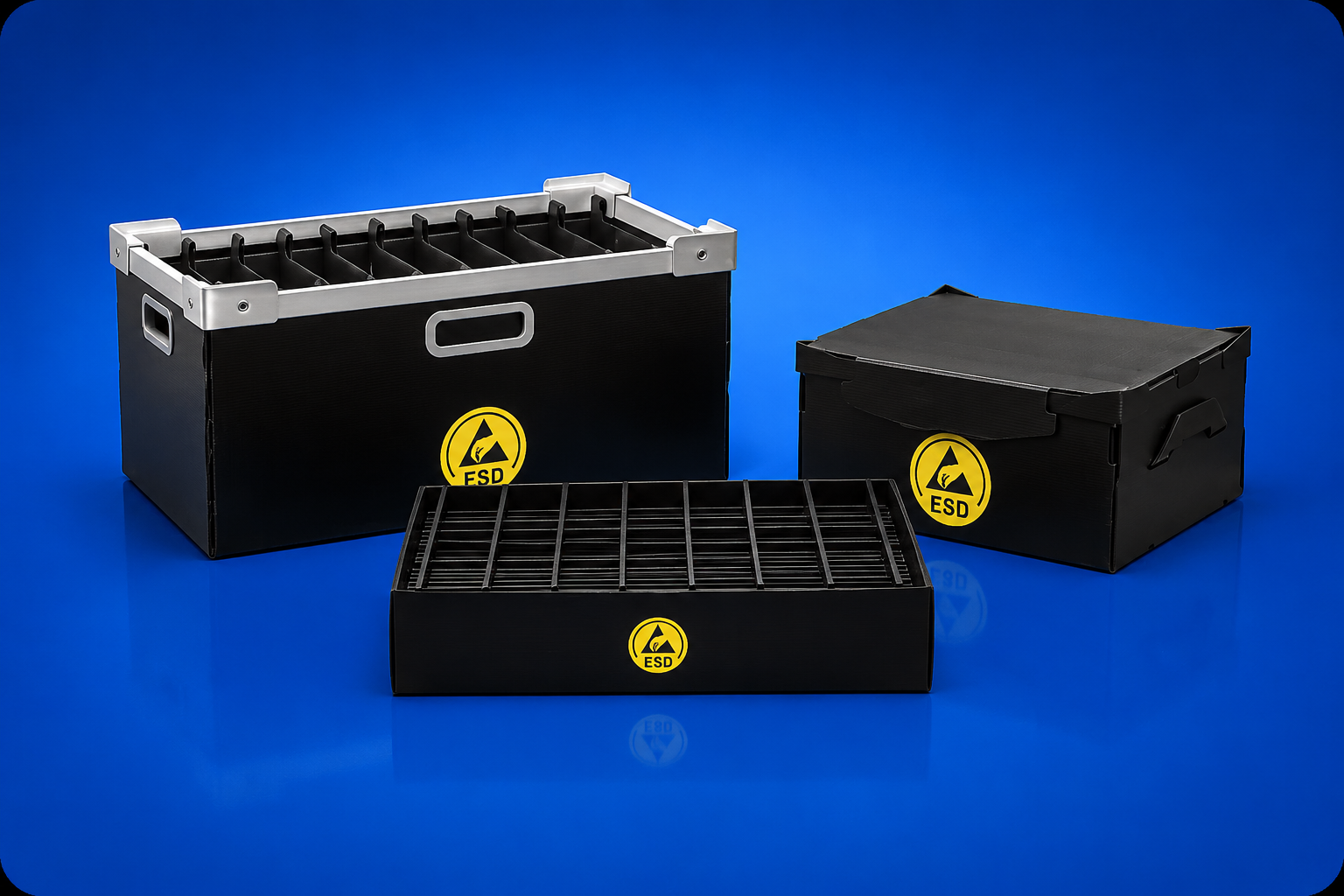
What Is ESD Packaging and Why Does It Matter?
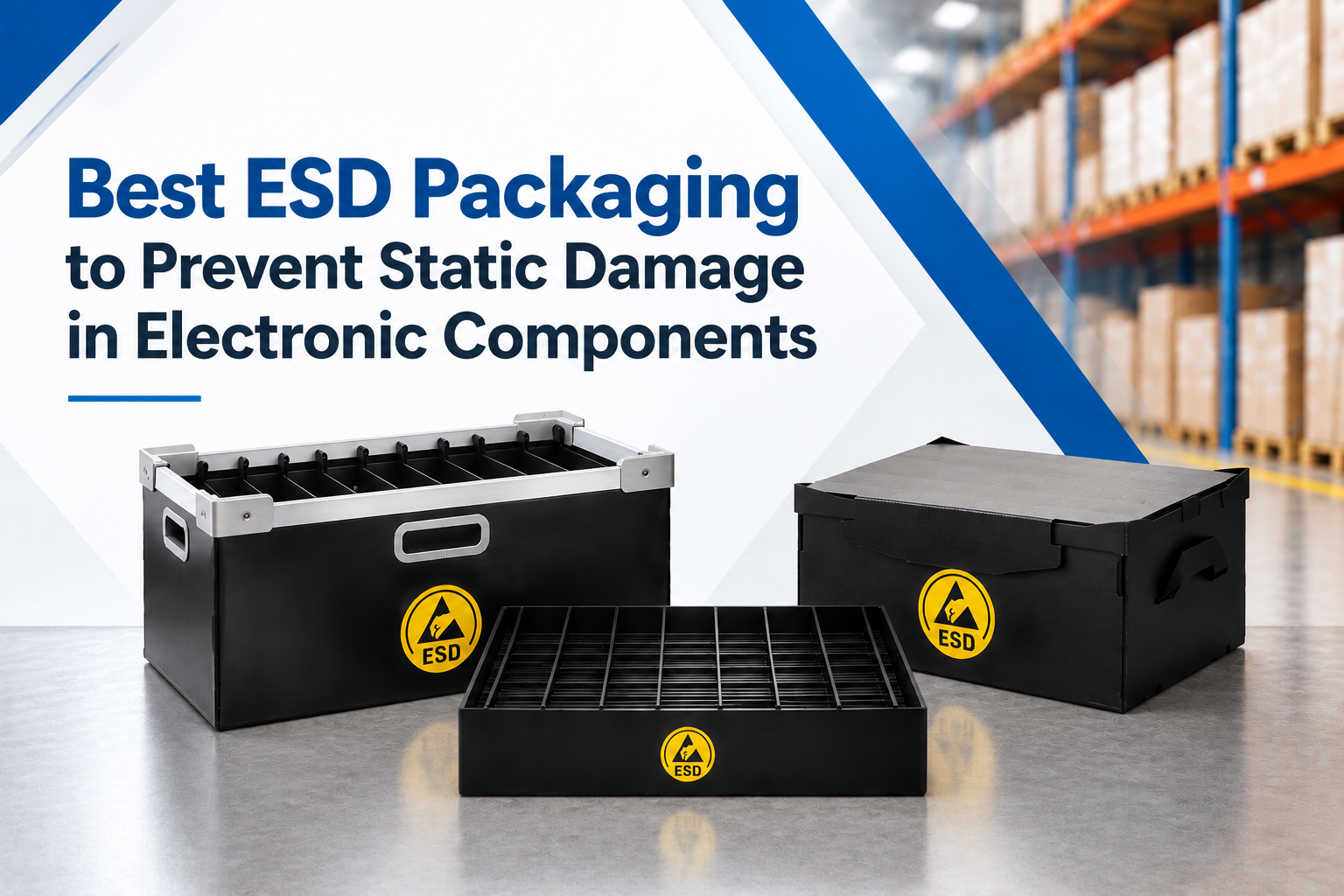
ESD packaging refers to containers, bags, trays, and bins engineered to control electrostatic charge around sensitive electronic components. The goal is simple: prevent charge from reaching the component surface in the first place.
Standard plastic packaging doesn’t just fail to protect it actively generates and holds static charge. A standard polypropylene bin in a production environment can accumulate enough charge to damage a component every time an operator reaches inside. That’s not a theoretical risk. It’s a documented failure mode across electronics supply chains.
The stakes matter because ESD damage rarely looks like damage:
- Hard failures: component stops working, caught at testing, replaced before shipping
- Latent failures: component passes every test, ships inside a finished product, fails in the field weeks later
Latent failures are the expensive ones. By the time they’re investigated, the packaging evidence is gone and the root cause is never correctly identified.
Types of ESD Packaging Solutions
Understanding the three categories of ESD packaging prevents the most common specification mistake treating all ESD-labelled products as equivalent.
1.Antistatic Packaging
Prevents charge generation on the packaging surface itself. Does not shield contents from external electrostatic fields.
- Surface resistance above 10¹² ohms
- Typical formats: pink antistatic bags, wrapping film
Best for: outer wrap where components are already inside a protective container
2.Static Dissipative Packaging
Allows charge to bleed off slowly and safely rather than discharging suddenly onto components.
- Surface resistance 10⁶ to 10¹¹ ohms
- Typical formats: grey or charcoal bins, storage trays, line-side containers
- Best for: EPA zone storage, line-side bins, in-plant material movement
This is the correct specification for most production environments. Grey dissipative bins are what most electronics factories in Ahmedabad actually need not conductive, which is routinely over-specified and adds cost without meaningful benefit in standard handling.
3.Conductive and Shielding Packaging
Allows charge to flow freely and, in metallic formats, creates a Faraday cage around contents.
- Surface resistance below 10⁶ ohms
- Typical formats: metallic shielding bags, black carbon-loaded bins
- Best for: component transit between facilities, exposure to uncontrolled external fields
How to Choose the Right Anti-Static Boxes and Bins
The specification decision comes down to three questions.
What is your component’s ESD sensitivity class?
Component datasheets include a Human Body Model (HBM) rating. Class 0 and Class 1 components (below 2kV) require complete ESD system protection at every stage. Class 2 and above components have more tolerance but still require EPA controls during handling.
Where in the supply chain is the risk highest?
In-plant storage requires static dissipative bins on grounded surfaces. Transit between facilities requires metallic shielding bags. Long-term storage beyond 90 days requires dual bagging and humidity control. Each stage needs its own specification.
What is your foam insert rated for?
A dissipative bin with a standard EPE foam insert is not a complete ESD solution. Standard EPE foam is electrically insulative. For direct component contact, specify ESD-rated foam with surface resistance in the dissipative range. The bin and the insert both need to be specified correctly.
Common ESD Packaging Mistakes to Avoid
These errors appear repeatedly in electronics operations and each one compromises the protection the packaging is supposed to provide.
- Using antistatic bags as the only layer for transit they don’t shield from external fields
- Reusing metallic shielding bags with fold-line creases or micro-perforations any breach eliminates shielding
- Cleaning ESD bins with incompatible agents that degrade surface resistance over time
- Placing dissipative bins on ungrounded surfaces charge management requires a ground path
- Specifying conductive bins for general line-side use over-specified and adds cost without benefit in standard EPA environments
Shanti Polymers ESD Packaging Solutions in Ahmedabad
Shanti Polymers manufactures ESD anti-static boxes and bins at their ISO 9001:2015 certified Sanand GIDC facility in Ahmedabad. Material compliance documentation is available on request for quality audit submissions.
Their manufacturing capability covers the full packaging system ESD bins, EPE foam fitments, PP corrugated outer boxes, and air bubble products which means the bin, insert, outer packaging, and transit wrap can be specified and sourced consistently from one supplier.