
A warehouse manager in Gujarat once calculated how much floor space his team was using to store empty rigid bins waiting for the next delivery cycle. The number was uncomfortable. Roughly 30 percent of his storage area was occupied by containers that held nothing just sitting there, waiting, taking up space and costing money.
He switched to plastic foldable containers. The empty return stack that previously filled a third of his warehouse now fits in one corner. Return freight costs dropped. Handling time at dispatch dropped. The containers themselves outlasted the rigid bins they replaced.
This is the conversation happening across Gujarat’s automotive, pharmaceutical, and FMCG supply chains right now. And if your operation still runs on rigid boxes with no return strategy, it’s worth understanding what you’re leaving on the table.
What Are Plastic Foldable Containers?
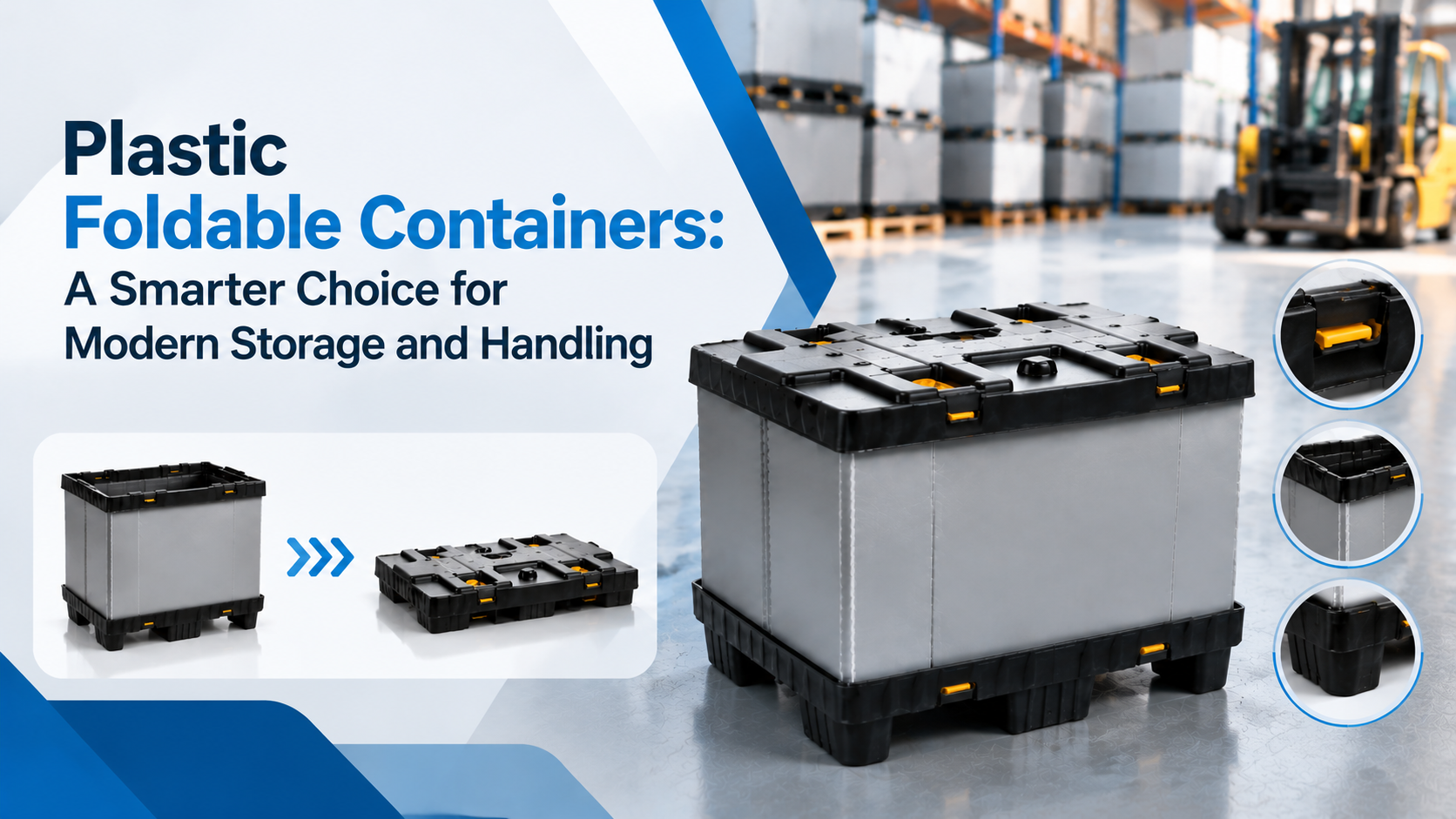
Plastic foldable containers also called FLC boxes Manufacturer in Ahmedabad or collapsible large containers are reusable storage and transit boxes built from polypropylene with hinged sidewalls that fold flat when the container is empty.
When assembled, they function as a standard rigid box stackable, load-bearing, suitable for fork handling and racking systems. When empty, the walls fold inward or downward and the container collapses to a fraction of its assembled height, typically 20 to 25 percent of the full volume.
That collapsibility is the core value proposition. It’s not a design gimmick it’s an operational and economic advantage that compounds across every return cycle in your supply chain.
Why Foldable Beats Rigid for Return Logistics
The comparison that matters is not unit price. It’s total cost across the asset’s operating life.
A rigid plastic bin costs less per unit than a foldable container of the same capacity. But a rigid bin occupies the same space empty as it does full. When it travels back from your customer’s site to your facility, you’re paying to transport air.
Consider a delivery of 100 FLC boxes to an automotive assembly plant in Ahmedabad. Once unloaded, those 100 containers fold flat and stack into a space equivalent to 15 to 20 assembled boxes. One return vehicle trip handles what would otherwise require five or six trips for rigid containers.
Across a full year of operations:
- Return freight cost drops by 60 to 80 percent for folded containers vs assembled rigid returns
- Storage footprint for empty containers reduces by 70 to 75 percent
- Handling time at the customer’s unloading bay reduces flat stacks are easier to move than assembled empty bins
These are not theoretical figures. They’re what operations managers report after switching from rigid to foldable large containers in captive supply chain loops.
Industries Where FLC Containers Make the Most Sense
Plastic foldable containers perform best in operations with predictable, repeated routes between fixed points. The return loop economics only work when you’re actually getting containers back.
Automotive supply chains: Component movement between Tier-1 suppliers and OEM assembly plants is the ideal application. Fixed routes, controlled handling, and frequent delivery schedules mean the return loop is reliable and the cost savings accumulate quickly.
Pharmaceutical and healthcare: Non-porous polypropylene surfaces meet hygiene requirements that cardboard cannot. Containers can be wiped clean between trips. For facilities in Ahmedabad’s Naroda pharmaceutical cluster, this hygiene compliance is as important as the logistics efficiency.
Agricultural produce: FLC containers are replacing wooden crates for fruit and vegetable transport in Gujarat. Lighter than wood, easier to clean, and the collapsible return makes them viable for agricultural supply chains where return logistics have traditionally been a cost problem.
FMCG warehousing: High-volume operations with frequent replenishment cycles benefit significantly from the storage space reduction when containers are returned empty and folded.
What to Look for When Sourcing Foldable Large Containers
Not all FLC boxes are manufactured to the same standard. These are the specification details worth confirming before a bulk order.
Load Rating
Confirm both the dynamic load rating (under forklift movement) and the static load rating (in racking or stacking). A container rated for 500 kg static but only 200 kg dynamic will fail if fork handled at full capacity.
Hinge Durability
The hinge mechanism is the highest-wear component in a foldable container. Ask the manufacturer for a fold-cycle rating how many fold and assemble operations the hinge is designed for before failure risk increases. For automotive supply chains running 100 trips per year, a hinge rated for 500 cycles gives a five-year service life expectation.
Footprint Compatibility
Standard FLC boxes are designed around 1200mm x 1000mm or 1200mm x 800mm pallet footprints. Confirm the container footprint against your racking system, vehicle deck width, and customer-side requirements before ordering. Dimension mismatches discovered after bulk delivery are expensive to resolve.
Wall Thickness and Material Grade
Virgin polypropylene maintains consistent mechanical properties across temperature ranges and UV exposure. Recycled-content PP can introduce variability in wall strength and hinge durability. For supply chains with outdoor storage or temperature variation, confirm material grade with your supplier.
Shanti Polymers FLC Foldable Box Manufacturer in Ahmedabad
Shanti Polymers manufactures FLC foldable plastic pallet boxes at their ISO 9001:2015 certified Sanand GIDC facility in Ahmedabad. As a direct FLC foldable box manufacturer in Ahmedabad, they work with operations and purchase teams from specification through to prototype testing before bulk production.
Their range also includes PP corrugated boxes and bins, HDPE plastic crates, and EPE foam fitments meaning the foldable container and its internal foam protection can be sourced and specified together.
Looking for a reliable FLC foldable box manufacturer in Ahmedabad? Contact Shanti Polymers at shantipolymers.in today for expert guidance on foldable container specification, prototype samples, and bulk pricing for your supply chain requirements.
FLC foldable boxes are used for safe storage, handling, and transportation of industrial products. Shanti Polymers provides durable foldable box solutions for various business needs.
Foldable boxes save storage space, offer better durability, and can be reused multiple times, making them a cost-effective packaging choice.
Shanti Polymers is a trusted FLC foldable box manufacturer in Ahmedabad, offering quality plastic packaging solutions for industries.
Yes, FLC foldable boxes are widely used in automotive, engineering, electronics, and manufacturing industries for efficient material handling.
Yes, Shanti Polymers provides customized FLC foldable box solutions based on size, design, and industrial packaging requirements.